The Side Wall That Started Bowing Out
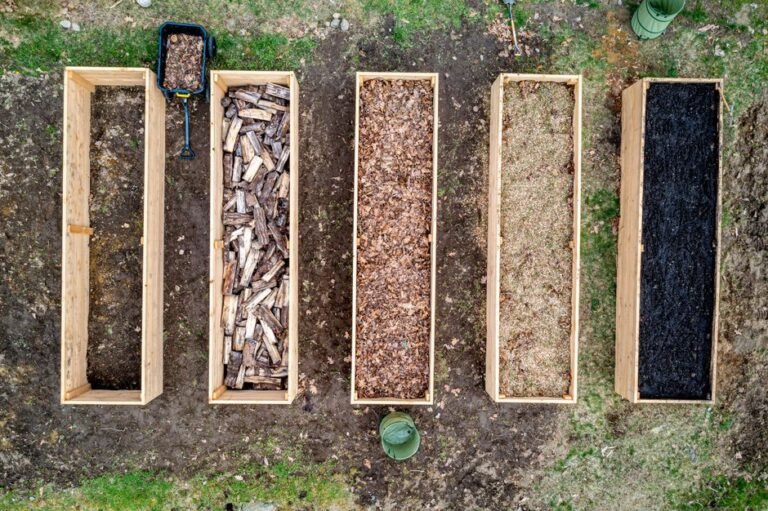
I was dragging the hose across the yard one evening in March, not really looking at anything, when I noticed the west side wall of our third raised bed was pushing outward at the middle. Not a lot. Maybe half an inch. But enough that when I pressed my palm against the board, it gave a little, like it wanted to keep going. That bed is the one closest to the fence, filled with soil for going on four years now, and I had never once looked at it as anything other than a box that was just there, doing its job. I finished watering, set the hose down, and stood there pressing on that board for a good minute, trying to decide if I was imagining it.
The bulge I almost ignored
My first instinct was to blame the wood. It is cedar, the same as the other beds, and I figured a board had warped in the sun the way fence boards do. I walked away and told myself I would deal with it later in the week. Later in the week turned into later in the month, the way these things do, and by the time I actually crouched down to look closer, the bulge had gotten worse. The middle of that wall was now curved enough that I could slide two fingers behind it at the widest point. I remember feeling a little embarrassed that I had let it sit that long, since it is exactly the kind of small thing I usually catch early.
What was actually happening underneath
Once I stopped assuming it was the wood and started looking at the whole wall, it made more sense. The bed is filled almost to the top with soil that gets topped off every spring, and wet soil is heavy. All that weight pushes outward against the walls all the time, not just when it rains, and a board that is only fastened at the corners has nothing in the middle holding it in against that pressure. Six years of freezing, thawing, watering, and settling had slowly worked the corner screws looser too, so the wall had less to hold onto than it did when Theo and I first built it. I went and checked the other three beds that same afternoon, pressing on every wall the same way, and none of them had the same give, which told me this was specific to that one wall rather than something wrong with every bed we owned.
The quick fix that did not actually fix anything
My first move was to grab a scrap two by four, prop it diagonally against the outside of the bulging wall, and stake the bottom end into the ground. It looked reasonable. It held the wall from bowing out any further, at least for about a week. Then I noticed the stake had started leaning, because the ground next to a raised bed is not exactly solid, and the whole brace had shifted a couple inches out of position. It was not attached to the bed itself, just wedged against it, so any time I brushed past it with the wheelbarrow it moved. I had solved the problem for exactly as long as nothing touched it, which in an active yard is not very long. Within two weeks the bulge had crept back to about where it started, and the leaning stake was more of a tripping hazard than a repair at that point.
Building a brace that actually held
What worked was less clever and more boring. I cut a length of scrap lumber to match the height of the wall, screwed it flat against the inside face of the bed at the point where the bulge was worst, so it acted like a vertical rib running from the bottom board to the top. Then I ran a second horizontal piece across the outside of the wall at the midpoint, screwed through into the end posts on either side, basically adding a second point of attachment where before there had only been the two corners. Between the inside rib and the outside crosspiece, the wall had something holding it at the middle instead of relying entirely on corner joints that were already tired. I used longer screws than I normally would for a job like that, wanting them to bite deep into solid wood rather than just catch the surface.
Refilling and watching it settle
After the brace was in, I pulled soil away from that wall by a few inches, tamped it down a bit firmer than I normally would, and refilled it in stages over about a week instead of dumping a full wheelbarrow load against the repaired wall all at once. I wanted to give the screws and the wood time to settle into the new load gradually rather than test the whole repair on day one. It held. I checked it every few days that first month out of habit more than worry, pressing my palm against the board the same way I had back in March, and it stayed flat. By early summer I had mostly stopped thinking about it, which is really the whole point of a repair that works.
What I understand now that I did not then
The lesson that stuck with me is that a raised bed wall is basically a retaining wall in miniature, and it needs to be treated like one from the start, not patched after the fact. On the newest bed, the one we built last year, Theo and I added a center support post on the two longer sides before we ever filled it with soil, just a simple piece running from ground level to the top edge, screwed to the middle of the board. It is not attractive. Nobody would notice it under a coat of paint. But it means that wall has something to lean on besides the corners, and I would rather build that in early than come out one evening in a few years and find it pushing on my hand again.